Pages

Thursday, 5 November 2015

Now Playing: System Shock

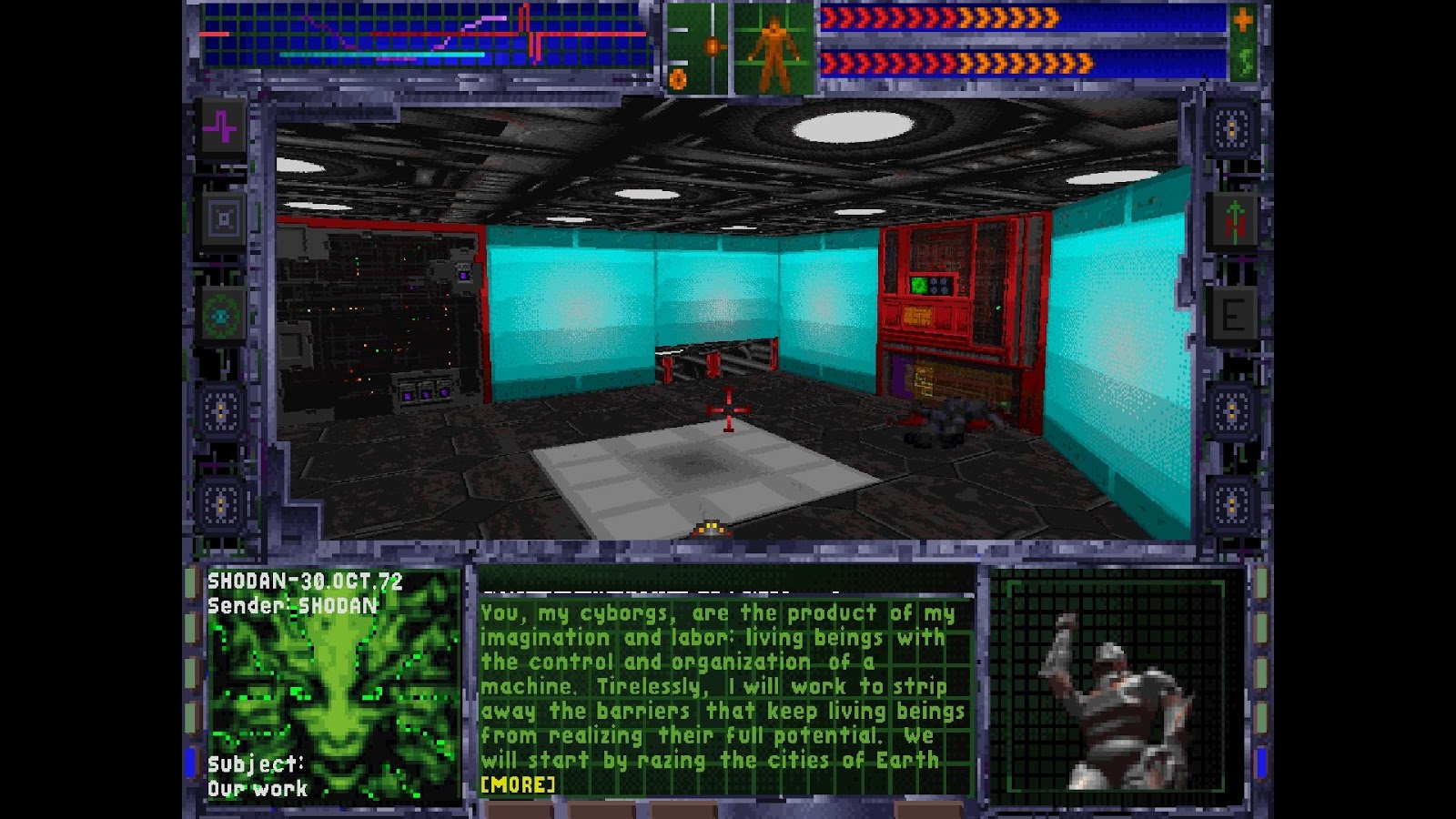
System Shock 2 is one of, if not my favourite game of all time. But I never played the original, not until many years after the release of SS2. Unfortunately, there were numerous compatibility issues with the version I had which prevented me from progressing beyond the first level. So when this ‘enhanced’ edition of System Shock was released, I just had to pick it up. This was the first time I’ve played System Shock to completion. It’s also, I must admit, probably going to be the last.

Now, don’t get the wrong idea. System Shock is a decent game. But everything System Shock does, System Shock 2 does better. Far better. My primary issues with System Shock are its level design and mission structure. I’ve seen SS1 praised for its complexity of level design, but I’d argue that convoluted is a more apt description.

The level design in SS2 is fantastic. Every deck has a logic to its layout with regards to the overall structure of the ship. Every location and corridor has a consistency to design and an obvious purpose. As you traverse the ship, it feels like a real place. Sadly, I can’t say the same about SS1. 
 
Every level of SS1 feels more like a maze. Aside from the odd section, the majority of each deck doesn’t serve any purpose, or adhere to an overall cohesive structure. There’s a lot of corridors/service ducts which lead nowhere or simply loop back on themselves. There’s a lot of empty rooms and pointless ramps or raised blocks/pillars. There’s gravity elevators in strange positions, and rooms with bizarre platform puzzles.

 
As a result, none of it feels like a real place, where people once lived or worked. There’s no logic to its layout, and no consistency in terms of design between decks. With all the looping corridors, ramps and gravity elevators it honestly feels more like a Quake or Unreal multiplayer map.

To make matters worse, there’s also little in the way of obvious landmarks to get your bearings as you attempt to navigate this needlessly convoluted maze. It’s not challenging as such – more tedious. And this leads us directly into my second major issue – mission structure.

In SS2, your objectives are always very clear. Not just in terms of where you must go and what you must do, but also why. SS1, however, is vague in every respect. On each level you’ll be searching for audio logs. These provide clues as to what you should be doing to progress. This is why it’s very important to fully explore every deck – if you miss a log or two, you may also miss a key piece of information.

But even once you have all the logs and a rough notion of where you should be going and what you’re supposed to do, the game doesn’t give a very good sense of why. I was very thorough in terms of collecting the logs and exploring every deck, but even so, there were a lot of times when I just didn’t get why I was supposed to be doing something or how it would enable me to progress. I didn’t understand the logic behind certain actions, and I frequently found myself backtracking through levels trying to figure out what I’d missed.

 
The game doesn’t do a very good job of putting a clear set of objectives before the player. A lot of the time, you’ll only have a vague notion of exactly what you’re supposed to be doing or why. You’ll be stumbling your way through objectives, without ever quite being sure that what you’re doing is right. It’s something that improves as the game progresses, but it’s still rather frustrating, and it significantly weakens the narrative aspects of the game.

Exploration is hampered somewhat by the UI and controls. Even with the addition of mouselook and key mapping, SS1 is a fiddly game to play. It’s not too bad once you become familiar with the hotkeys for switching between various tabs of the interface, but compared to SS2, you feel like you’re struggling more against the UI and controls than anything the game can throw at you.

The enemies of SS1 don’t put up much of a fight. Weapons and ammo are fairly plentiful, (for reference, I played on the Normal difficulty) and the only times I really ran into trouble was on the occasions when the game spawned a large number of enemies practically right on top of me – which felt more cheap than challenging.

Graphically, SS1 still looks okay. Some areas hold up better than others. Although the game lacks a consistency to design, it still has some striking environments to explore. In terms of sound, the music seemed to kick in and out at odd moments, which I think might be a bug. Combat would occasionally be completely silent, although admittedly, that was preferable at times as the looping tracks grew rather repetitive.

 
Like SS2, the best thing about SS1 is SHODAN and your interactions with this devious AI. Unfortunately, this interaction is limited to odd messages sprinkled throughout the game. Combat is basic as is enemy AI. There’s little to differentiate the enemies or how to tackle them. The weapon selection is decent, but there’s a lack of variety in terms of how they handle.

As I’ve already said, everything SS1 does, SS2 does far better. In terms of story, environments, missions, enemies, weapons and controls, SS1 is rather basic compared to its sequel. Whereas SS2 still holds up solidly today in terms of its mechanics…SS1 – not so much.

Upon release, I can see why so many aspects of SS1 would have been considered impressive. But SS2 took those aspects and refined and improved them so much that it’s hard to recommend SS1 over its sequel. I still had some fun playing it through, and there are some genuinely well designed sections, but it’s not a game I can honestly say I feel any great desire to ever play again.

6/10

Wednesday, 28 October 2015

Fallout 4: S.P.E.C.I.A.L


In preparation for Fallout 4 there’s a neat little character builder available at Vault111. It’s based on limited pre-release information and is incomplete in terms of perk descriptions, but it should give you something fun to tinker with until November 10.

Friday, 23 October 2015

Now Playing: Life is Strange

Before continuing with this review, I’d recommend reading my previous post on Life is Strange. It covers my thoughts on episodes 1-4. This review will focus primarily on the final episode and ending. I’ll try to keep it as spoiler free as I can.

Okay, so if you’ve read my previous post, you’ll know I rather liked the first four episodes of LiS. My concern, however, was if the final episode could tie everything together and provide a satisfying conclusion. The answer is – yes…and no.

The final episode of LiS is far from perfect, and it doesn’t quite hit the mark in the way you feel that it should. But it’s certainly not a total f**k up either. In fact, I quite liked the ending. It felt thematically consistent to what the previous four episodes were building towards. Which is a fancy way of saying the ending was pretty much exactly what I expected it to be. There were no twists or surprises, but rather a sad inevitability.

I’m sure this will be disappointing for some people, but I actually thought this was an interesting decision and one that fits perfectly with the themes of LiS. The main character, Max, has the ability to ‘rewind’ time. And with great power…well, you know how it goes. Max uses this ability to change fate. But doing so is not without consequence.

 
Early on in the game we see Max’s power take a toll on her physically. It’s not a power she can freely abuse, and it’s certainly not without its limits. Max, being the good person that she is, uses her power to try to help people, but throughout the game, her attempts to ‘fix’ or change time often results in unforeseen negative effects.

And that’s really what the game is trying to tell you – Max may have a great power, but changing fate and rewriting history can come at an even greater cost. The ending puts the player in the position of deciding if they’re willing to pay that cost. It’s a conclusion I think many people were expecting but honestly, I don’t see any other way it could have ended.

Everything in the game, even a lot of the small choices, seem to push the player towards the realisation that no matter what they do or choose, at some point the bill has to be paid. And as powerful as Max is, she can’t save or ‘fix’ everything. Something has give, and nature must balance its books.

Another important aspect of the narrative is the notion of ‘moments in time’. Moments in time matter – to Max, and to the player – even if they’ll be erased. There’s a wonderful sequence during the final stages where Max revisits many key moments throughout the game – a winding path that guides her back to Chloe. This is just my interpretation of it, but what I took from it is this – even if these moments are reset or erased, they still exist, and Max still carries the memories of them.

 
At the end, the player has the choice to reset fate, or to change it and pay the price. But choosing to reset time doesn’t suddenly render your choices meaningless. The choices you’ve made throughout the game are important in the sense that they’ll shape the memories Max (and you) will carry forwards.

When Max uses her power it may be with the best of intentions, but it also upsets the ‘natural’ order. Changing fate is not without a cost, and the game reinforces this notion throughout in both large choices and small. Which is why the ending (and the choice the player has to make) feels both appropriate, necessary and, like I said, sadly inevitable.

Now, although I liked the ending and the way it built up, that doesn’t mean I think it’s perfect. The final episode feels rushed in places, and I don’t think it’s constructed in a way that quite hits the emotional highs it feels it should. I know people might be disappointed at the lack of explanation for Max’s powers. In fact, it doesn’t attempt to address the science/supernatural aspects at all.

But this honestly didn’t bother me because the game was never really about that. At its heart, this was a story about two girls. They were like the eye of the storm, and everything else revolved around them and their relationship. The final episode may stumble in places, and perhaps it does leave a little too much to interpretation, but I think it does just enough to provide a satisfying conclusion.

It also has some very strong sequences. There’s an ‘escape’ sequence early on that’s a lot of fun and unintentionally hilarious. There’s also a ‘nightmare’ sequence which is brilliantly handled – with the exception of a silly ‘stealth’ style section. I’ve seen people talk about it like a ‘dream’ sequence, but my interpretation is that it’s more of a ‘tear’ in reality.

 
The final episode sees Max use her power repeatedly as she grows increasingly desperate in an attempt to ‘fix’ everything. But doing so causes time and reality to unravel around her, eventually leading to a dark and disturbing nightmare reality. It’s almost like time is collapsing around Max. Her meddling could see her lost in time completely, but it’s her memories of Chloe and those moments in time they shared together that guide her back.

And I really liked this notion, of time fracturing around Max. She’s so desperate to save everyone, but ultimately she has to understand that she can’t – time always catches up to you, and changing fate is not without a cost. There has to be a balance.

I’ve played through LiS twice and seen both endings, both of which feel thematically consistent with the themes raised throughout the experience – you can’t cheat fate, not without paying a price. In some ways, it’s kind of a depressing notion, but it feels wholly appropriate and what the entire game is constructed around.

Overall, Life is Strange is one of my favourite games of the year. It has its missteps and stumbles, and maybe my interpretation is totally wrong. But this is a game very much about what you choose to take with you, what memories you want to hold on to. Every moment in time has its purpose. And even if you choose to reset time, those moments aren’t lost or erased. Not for Max. Not for you.

8/10

Saturday, 17 October 2015

Tuesday, 13 October 2015

Star Wars: Battlefront (BETA)

Following the disappointing Rainbow Six: Siege beta, I jumped straight into the Star Wars: Battlefront beta which I’m pleased to say, was actually rather fun. It’s not without its problems, however, and it’s not a game I’ll be picking up on release for reasons I’ll explain later. But let’s start with the good stuff, shall we?

Unlike the Siege beta, the matchmaking actually worked and I didn’t have any trouble getting into games. The menu system was also refreshingly neat and simple to use with regards to class customisation, and the in-game UI was tidy and unobtrusive. Starting up the game and jumping into a match barely took a couple of minutes. Technical performance was really good with a solid 60FPS at all times, even when running everything on High.

Battlefront is one of the best looking games I’ve played this year. The landscapes of the maps in particular are fantastic. Character and vehicle models look great, as do all the effects such as explosions and laser blasts. Battlefront also has excellent audio with effects and music ripped straight out of the films. The visual and sound design combines to create an authentic and atmospheric recreation of the Star Wars universe.

If you’re expecting Battlefront to play more like a Battlefield title, you might be disappointed. It’s actually far more fast paced and doesn’t so much have a skill/learning curve as it does a straight line. I wouldn’t say this is necessarily a bad thing though. It’s undeniably simple and shallow, but also very easy to pick up and play, and most importantly – fun. Which is fine, but it does raise questions about long term appeal.

 
There were three modes and maps available in the beta. One was a solo or co-op horde mode which was instantly forgettable. Another was a 8v8 ‘capture the pod’ mode. Fun, but limited. The only mode really worth talking about in depth was ‘Walker Assault’ a 20v20 objective based recreation of the Battle of Hoth from The Empire Strikes Back.

Now, it should be said that this beta wasn’t only limited in terms of maps and modes but also weapons, abilities and unlocks. It only allowed you to level up to rank 5, and only provided a very small selection of abilities. It may be that in the full release, there’s a lot more to these aspects that really change the game and add more depth, so keep that in mind.

But based on what I’ve played and what was available in the beta, Battlefront is a fun but shallow experience. I liked how the weapons handled, especially the overheat and ‘quick reload’ mechanic, but ultimately, there was very little to differentiate the different blasters. There’s no classes as such, and customisation is handled by picking three ability cards – a sniper rifle, a grenade type, a jet pack etc. I thought that was neat, but with such a limited selection, everyone pretty much rolled with the same gear.

The spectacle of ground combat is where Battlefront really shines. The graphics, the effects, the sound all combine to create a fantastic and immersive Star Wars experience. It genuinely feels like you’re in The Empire Strikes Back. I couldn’t praise it enough for capturing that feeling. Of course, the question is, if this wasn’t a Star Wars game, would I enjoy it half as much? Probably not. But that’s the power of the licence, and it proves just how strong it remains all these years later.

I think the best way to describe the gameplay is that it’s very ‘arcade’. It’s very easy to pick up and play. There really is no learning curve involved, even with vehicles. Everything controls much the same, with 3 special abilities to activate in addition to a primary attack. The ships, which I was expecting to be hard to master, are actually surprisingly easy. I wouldn’t say their handling is all that great, but they are refreshingly simple to fly.

 
A big problem with the aerial combat, however, is the size of the map. On the ground, it seems large enough, and you’re never too far from the action, but in the air, you suddenly realise how small it really is and you feel like you’re simply flying in a constant circle. The game also has ‘hero’ pick ups that let you play temporarily as Luke or Vader, but the heroes are actually pretty underwhelming to play and very easy to kill.

I liked the way the game handled various pick-ups, including the heroes and vehicles. You’ll find them as random token spawns across the map so it gives everyone a chance to find one and have a go, rather than just one asshole camping their spawn points. The only downside to this, is that the Hoth map can be won or lost quite easily in the air, especially for the Rebels, so if you keep getting idiots on your team picking up the tokens and crashing your air support into the ground, you’re kind of f**ked.

But overall, I liked the the token spawn idea (although placement needs some work as the Rebel side tokens are way too exposed). It’s just a shame the player spawns are so badly handled. The Rebel spawns on Hoth in particular are awful – during the last stage, the Rebels spawn on an open hill in full view of the AT-ATs guns. And then we have the ‘partner’ spawn mechanic which means enemies can just pop up right next to the guy you’re shooting.

In terms of balance, the Hoth map is heavily weighted in favour of the Imperials. That doesn’t mean it’s impossible to win as the Rebels, because I have, but only in say, 2 in every 10 games. The difference is this – the Imperials can play like shit and still have a good chance of winning. The Rebels on the other hand have to work together, play as a team and focus on the objectives if they want to stand any chance.

For some reason the game spawns the Rebels pretty far from their first line of defence and puts their pick up tokens right out in the open. The Imperials can not only reach the first objective points more easily with significant cover, but also have an advantage in terms of height and vehicles. The second stage is even worse, as it allows an AT-AT to fire unopposed straight into the heart of the Rebel base with a clear line of fire at the objective point.

 
That said, if your team pulls together as the Rebels you can actually win quite easily. But in a public game, it’s a bit shitty when one side requires teamwork and coordination to win and the other doesn’t, because it’s rare you’ll find so many players working together, rather than just running about, ignoring objectives and fretting about their kill count. Oh, and people hacking. Maybe it’s a beta issue with false readings, but every match I saw at least 10 people being kicked by the anti-cheat. In a f**king beta. Why people bother, I really can’t say.

As you can probably tell, I’m now sliding into the negative aspects of Battlefront. It was a lot of fun, but where’s the long term appeal? Without any skill curve, or a variety of mechanics to master, where’s the depth? What’s going to keep me playing? I mean, let’s compare this to Titanfall. That was a game with greater weapon and ability variety, which also had the free running and titan combat, both of which took time to learn and perfect. There’s nothing like that in Battlefront. Not in infantry or vehicle combat.

And I really wouldn’t mind that so much. There’s nothing wrong with a basic, arcade style shooter that focuses on quick, easy fun. But for 50 quid? And that’s just the ‘standard’ edition. 50 quid for a online only shooter with no single player campaign, only 12 release maps and a handful of game modes? As much as I enjoyed the beta and had fun with it, I don’t see myself getting more than 20-30 hours out of it before it gets repetitive, especially with such limited content. With shallow and simplistic gameplay, Battlefront really needed to hit the mark with content, offering a wealth and variety to keep the player engaged.

But it doesn’t. And I’ll be f**ked if I’m going to pay 50 quid for 12 maps before they start pumping out DLC. Especially considering Fallout 4 releases 9 days earlier and is 10 quid cheaper. I have my reservations about that title, but getting good value for money out of it isn’t one of them.

All that said, I have to reiterate how much fun I had with Battlefront. Yes it’s a very shallow and simple shooter, at least based on what I’ve seen in the beta, but it’s f**king STAR WARS and it captures the license perfectly. If I see it on sale for 15 or 20 quid in the future, and the game isn’t totally dead, I might just pick it up. Hell, I’d probably get it on release if it was half the price or had double the amount of content.

Wednesday, 7 October 2015

Rainbow Six: Siege (BETA)

IT’S HAVOC!

I wasn’t sure if I should do a post on this considering how little time I spent playing this beta. But it certainly wasn’t through lack of trying. Because in the 8 or so hours I ‘played’, I’d guess that 4 or so was spent staring at a non-responsive matchmaking screen.

I only heard about the beta on what was intended to be the last day. Fortunately it was extended for a few more, so I figured I’d give it a shot. I’d liked the look of that original demo they showed at E3 a few years ago. It’s a shame that’s not the game I actually got to play.

Siege feels like an inferior CS:GO. What was promised, and what was originally shown, appeared to be more of a strategic, tactical based team shooter. You know, something more in line with the original Rainbow Six games. In reality, Siege has all the strategic and tactical nuance of a Call of Duty title.


Movement and weapon handling felt very, very odd. I got used to it, but movement in particular never felt quite right, especially when attempting to climb or vault over obstacles. It lacks a fluidity that results in simple actions being far more awkward than they should be. The guns have a recoil that also feels a little off. Although to be fair, I might have just needed more time with the game to become familiar with it.

That said, hit detection definitely feels off. Several times I was certain I’d hit an enemy only for there to be no reaction. It always seemed to be when the enemy was prone, however, so maybe it’s just an issue with the stance. Graphically, Siege looks decent. Like the recent BOPS3 beta, its visuals do the job but they’ll hardly blow you away. Technical performance seems solid.

The beta included three modes. One was a solo or co-op versus the AI mode. You just shoot bots. Some of them run at you and explode. That’s about it. The other two modes were a team bomb and ‘secure area’ mode. They’re pretty much self-explanatory. There were three maps to play across, and the maps were certainly one of the better elements with multiple levels, rooms and entry points.

IT’S HAVOC!

More positives include the destructible environments and the ability to blow open windows whilst hanging upside down before swinging into a room like John McClane. That shit is fun. Unfortunately, matches rarely last long enough to appreciate the maps or the destruction physics. Often matches are over in 2-3 minutes, quickly devolving into short, deadly shoot-outs.


A big part of this problem seems to be the way the maps place objective points, such as in the bomb mode. There are two bombs, but they’re often placed within close proximity, and that’s where the action will generally kick off. But it doesn’t really last very long, and the teams – 5v5 (although often due to the shoddy matchmaking it would be 3v5 or 4v5) – aren’t really big enough to make full use of the maps.

Each round has an annoyingly short preparation phase, particularly if you’re on the defensive. If you were expecting a more slow paced, thoughtful style of shooter, you’ll be sorely disappointed. With one or two exceptions, matches in Siege are determined entirely by twitch shooting, with many players choosing to remain prone and camp corners because it’s so easy to be randomly killed by stray shots through walls.

The menu systems in the game are needlessly convoluted and slow to function, especially when trying to customise an ‘operator’. These are your classes, and you’ll spend ‘renown’ on unlocking various upgrades to each. I didn’t have enough time with the game to fully explore what was on offer but honestly, it didn’t feel like the operators really made much difference to the experience. You’ll be just as successful rolling with the default recruit class as long as you’re quick on the draw.

IT’S HAVOC!

But as I said at the beginning of this post, I spent so little time actually playing the beta that it’s hard to really judge it. The matchmaking during my time with the beta was f**king terrible. I’d spend 4-5 minutes just to join a team, only to then spend another 4-5 waiting to find an opposing team, which then never appeared so everyone just quits.


Even when I’d find a team, it would often connect me to a match just finishing and showing the final score, before kicking me straight back to the matchmaking screen. And then I had problems with getting kicked due to server errors, or during host migrations. It seemed it would take about 5-10 minutes just to get into a full match from the beginning, but the match would often be over in less time than it took to connect and load.

And even once the match was done, staying in the same team was hit and miss as I often got kicked back to the menu due to an error. Oh, and there was also a bug that halted loading matches before they began, forcing whoever was hit by the bug to quit and causing an imbalance in the teams. Hell, the game doesn’t even address team balance at all. In one game it was just me versus 5 others.

I know this is only a beta, but with the game’s matchmaking in such a shoddy state it doesn’t bode well for the full release, especially not with all these other bugs and errors. Overall, what little I played of Siege was disappointing. Even ignoring all the connection issues and the shit menu and operator/upgrade system, simply in terms of its gameplay, Siege just wasn’t very fun.

It’s a shame, because there is potentially a really enjoyable tactical team based shooter in here, somewhere. Something closer to what they originally unveiled. But since then, for whatever reason, we’ve ended up with a shoddy mixture of CS:GO & CoD thats not half as fun as either.

IT’S HAVOC!