


I recalled very little of the original Resident Evil 3 going into this remake so, like my review of the Resident Evil 2 remake, this review isn’t going to serve as a comparison of the original – not what it’s gained, or what it might have lost during the transition – but instead, a review of what we’ve got now.
And
as much as I did enjoy playing this remake, I have to say I’m still
quite disappointed by it. If I did have to make a comparison it would
be that this remake is to Resident Evil 2 what Resident Evil Zero was
to Resident Evil – a shorter, more linear, action focused but
ultimately forgettable companion piece.


I played through the campaign three times on all of the initial difficulty modes. My first run, on Standard, even when exploring every map for every collectible and item, was still over in 4 hours. My second run on the easiest ‘Assisted’ setting to pick up the few odd collectibles I’d missed was over in less than 2. And my third run on ‘Hardcore’ wasn’t much longer. I didn’t bother with the difficulties unlocked beyond Hardcore because after three separate runs, I felt like I’d seen everything the game had to offer.
I can’t say I didn’t enjoy each of my runs and I liked the addition of the ‘coin shop’ which lets you buy various items and weapons to mix up your play as you progress through the various difficulty modes. But that’s really what the game is focused upon – multiple, multiple runs on higher difficulties and more challenging ranking objectives. If you’re someone who just likes to play through a campaign once and move on, you’re going to feel very short-changed by this remake.


And to be frank, this remake does feel like it was knocked out on the cheap. It’s not just the length, but how much content is recycled from the Resident Evil 2 remake. The ‘sewer’ section in this remake may have a different layout, but it’s essentially the same environment you fought through in Resident Evil 2. You also return to the gun store from Resident Evil 2, and get to enjoy an extended return to the police station from Resident Evil 2. When a chunk of your game is just recycled content from the last and barely scrapes 4 hours in length, it ends up feeling more like a DLC.
And that’s the best way to describe how I feel about this remake – it feels like a DLC for Resident Evil 2. And I really liked Resident Evil 2, so I that’s why I still enjoyed playing this. But I’m damn glad I didn’t buy it at release or pay full price for it. That said, I picked it up at 50% off and I still feel a little ripped off.


The disappointing thing, is that this remake could have had so much more to offer – more locations, more puzzles and more sections where you switch between Jill ‘potty mouth’ Valentine and Carlos. We could have seen more of the city, more new locations and more new enemy types. The boss fights in the game are all pretty fun but also pretty easy once you’ve learnt the pattern.
And that’s kind of the problem with this ‘multiple run’ approach to design – once you’ve done it once, it gets easier every time. There’s no more surprises and despite the increasing difficulty, the game actually just gets easier, particularly if you use the coin shop to unlock various health, defence and attack boosters, not to mention unlimited ammo weapons. And why wouldn’t you? It’s all the game really has to offer beyond your first run – the ability to unlock items that makes each repeat play even easier than the last.Overall, I enjoyed playing this remake enough to play it through more than once, but by my third run, even I’d had enough. If you enjoyed the Resident Evil 2 remake then I’d still recommend picking this up but only on a significant discount.
6/10
The Furious Wild is the first ‘expansion’ content released for Total War: Three Kingdoms. It introduces a new culture type – the Nanman – and features a complete overhaul of the campaign map which has also been expanded to include several new regions in the south-west. Like with the other major DLC releases for 3K, this expansion is accompanied by a patch and free additional content, but this review will only focus upon the pieces that you’re actually paying for.
The Nanman come with four playable factions, each led by a unique character and each with their own unique campaign mechanics. The goal for each faction, however, remains the same – to unite all of the Nanman tribes beneath your banner and form your own Kingdom. Every tribe you confederate through conquest or diplomacy will bring new benefits to your faction through an increase in prestige, the rate of research or by unlocking new units.
Your initial army roster will be somewhat limited, but as each tribe falls beneath your control that roster will rapidly expand to include more than 25 new Nanman specific units. Sword, axe and spear units operate exactly as you’d expect in comparison to their Han equivalents. But the Nanman also get access to more ‘exotic’ units including elephants and tigers.


There are ways the Nanman can get access to the more traditional Han units, but I’m not sure why you’d want to play as the Nanman if you don’t want to create armies full of rampaging tigers and elephants. If you’re accustomed to playing as the Han factions then switching to the Nanman can take some getting used to, but once you do, playing as them in battle can be very enjoyable and they certainly add some welcome variety to the Three Kingdoms campaign.
The Nanman have their own system of government, although it operates, more or less, just like those of the Han factions. They also have their own unique technology tree and building types, although the core systems of character assignments, satisfaction, faction support, public order, corruption and income types (commerce, industry, peasantry) remains the same. And this is where we run into the main issue I really have with this DLC – the lack of unique cultural mechanics.
Nanman characters don’t have classes like those of the Han factions – no vanguards, champions or strategists. They are, however, subject to the same types of character stats and their related faction / unit benefits – cunning, for example. Nanman units, like their Han counterparts, are also subject to the class based system of ranged (blue) axe & sword (purple) cavalry (red) and spears (green). So a Nanman character with a high cunning (blue) stat, will always be more beneficial when in command of ranged (blue) units. This results in a situation where, even though Nanman characters are not class based, their units and the statistic boosts they provide to those units are.


If a Nanman character has a high cunning base stat, you’ll want to assign them as your unofficial ‘strategist’. These characters can then boost their stats in a particular skill as they level up, and unlock additional benefits by completing personal ‘missions’ based upon various actions – such as winning duels, killing enemies or by increasing the levels of particular units within their retinue.
To be clear, it’s not as if this system doesn’t work in practice, but it doesn’t feel quite right. As an entirely new culture type I would have expected the Nanman to utilise their own unique class system both for characters and units. Instead, we get a system which is really just a slight twist on the core class system and frankly, isn’t as interesting to manage from a character perspective.
And that’s my main criticism of this DLC – it doesn’t really go far enough to establish the Nanman as their own unique culture. Too many of the core systems remain the same aside from a slight tweak. Am I expecting too much? I don’t think so, not when this DLC is marketed and more importantly priced as a major expansion.
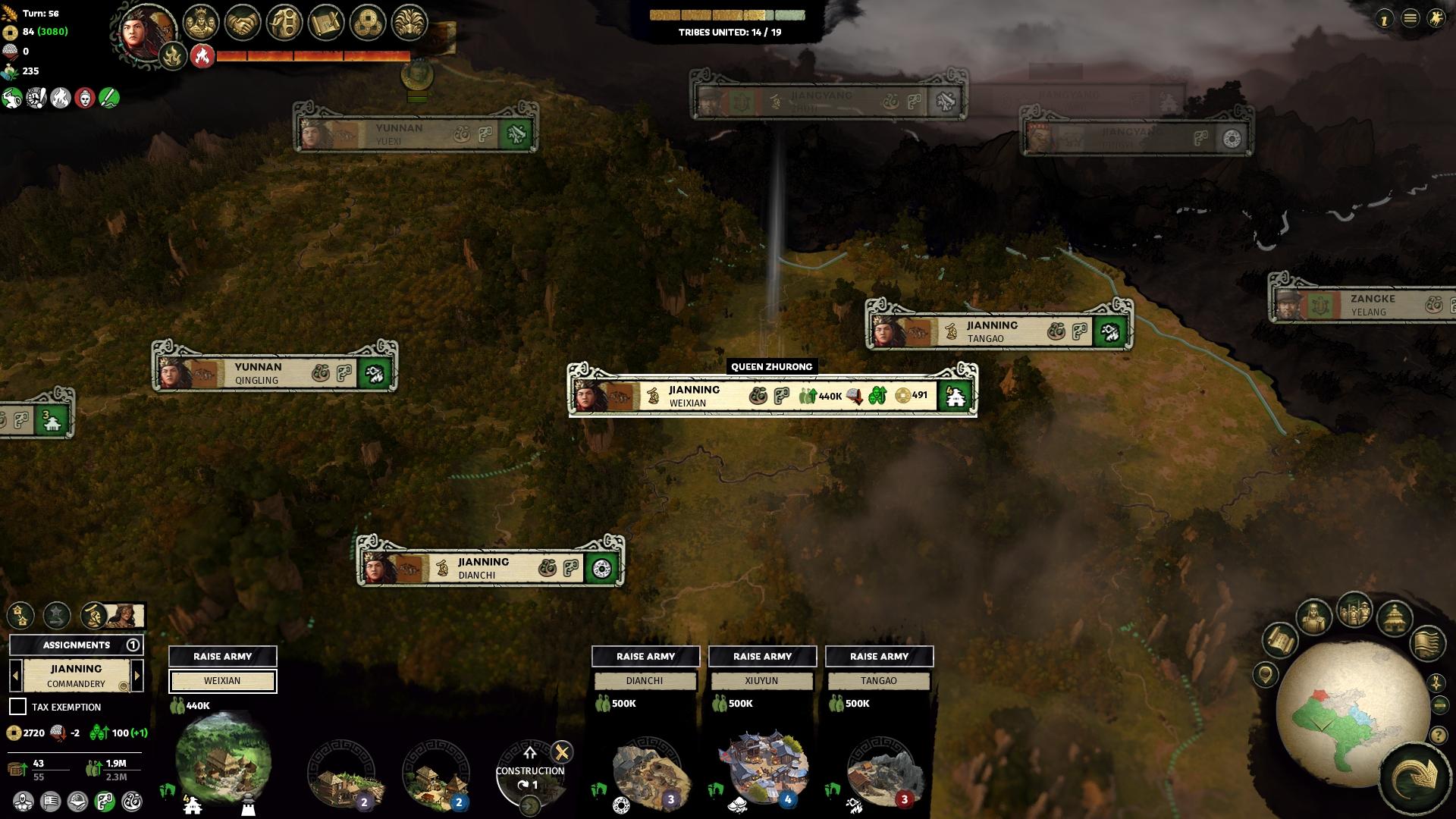

I do like the Nanman campaign. It feels like a mini-campaign playing out alongside the main campaign. Because of their starting location, you won’t really be interacting with the core factions, not until you unite the tribes and form the Nanman Kingdom. By this time the Han factions will have become more established and powerful and you may, like me, find yourself in a pretty fun and massive border war. But with the formation of the Kingdom your campaign is pretty much finished, and there’s not much incentive to continue on.
Overall, The Furious Wild is a welcome and decent expansion to Three Kingdoms, but I wouldn’t say it’s an essential one and I do feel the asking price is simply too high given how little of the core faction / character systems this DLC actually changes. The map overhaul is good, the new units are great and I’m glad there’s more variety and conflict centred around the once rather barren southern regions of the map. I’d recommend picking it up at some point, but maybe wait for a sale.
6/10


I played Halo 3 on its original release in 2007, but it’s been at least 10 years since I replayed it, so I was curious to see how it would stack up today compared to Halo 1 & 2. It’s generally regarded as one of – if not the best – Halo campaign and overall, that’s an assessment I’m inclined to agree with.
Halo 3 gets off to a somewhat slower start than Halo 2, but it soon ramps up into one of the most exciting and fun shooter campaigns you’ll ever play. Unlike Halo 2, which became more linear and restrictive as you progressed, Halo 3 plays to the key strength of the series – open, sandbox combat environments.


Playing either in solo or co-op is a blast as you navigate these open maps. And Halo 3, acting as the conclusion of the Human / Covenant war, includes plenty of large scale, vehicle based combat missions with plenty of friendly and enemy characters. Halo 3 took all of the best aspects of 1 & 2 and combined them into a thoroughly entertaining campaign from beginning to end – and one which wraps up this particular Halo story to a satisfying degree.
The combat is as smooth and enjoyable as ever – although noticeably easier than I recall, even on Legendary. The lack of shielded elites certainly makes a big difference, the checkpoints are more lenient than in Halo 2, and the co-op re-spawn system is also far more forgiving.


Somewhat disappointingly, this PC release hasn’t received much in the way of a visual overhaul, unlike Halo 1 & 2. I guess you could argue Halo 3 wasn’t in such a great need of visual improvement compared to those games – Halo 2 in particular – but it’s a shame more attention wasn’t given to the perfectly acceptable but obviously dated visuals.
The sound and music are as excellent as ever, with the classic Halo theme kicking in at all the right moments. The enemy AI continues to impress, although fighting the dim-witted brutes is never quite as challenging as fighting the sneaky elites.


Halo 3 also marks the end of the Halo games I had previously played so the next releases as part of the MCC – ODST and Halo 4 – will be my first time. I am curious to see where the story goes because Halo 3 does a pretty good job of wrapping things up. Like the others, Halo 3 also has plenty of collectibles to discover and score / time challenges to test your skills.
If I had to rate the Halo games I’ve played in some kind of order it would probably be Halo 3 = Halo 1 > Halo: Reach > Halo 2. I don’t know how the series progresses from here or what the future holds, but these four games provide a fantastic experience and really shouldn’t be missed if you’re a fan of engaging, first person shooter campaigns.
8/10


